
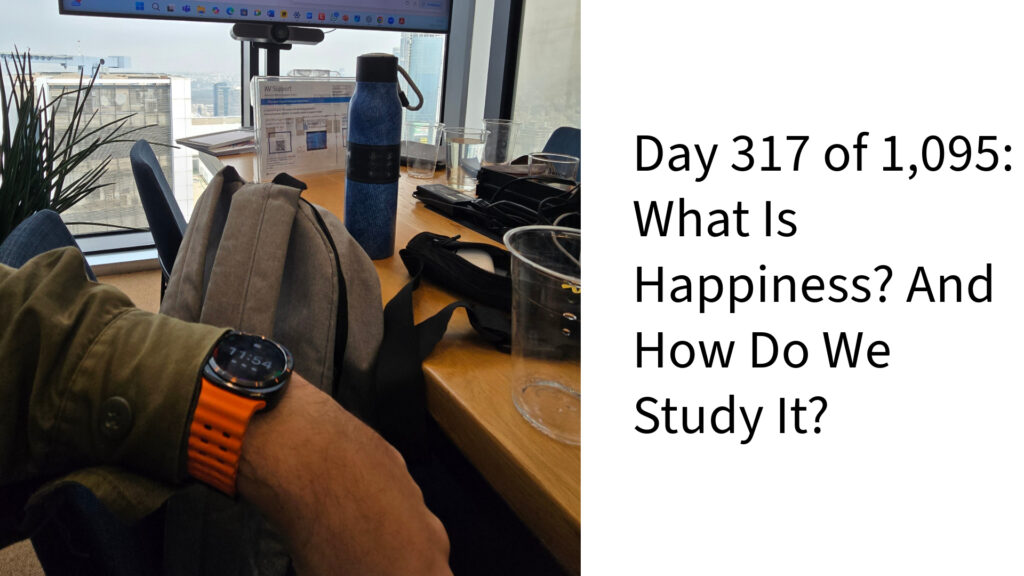
Today was packed—between product development and dealing with the ongoing, complex reality we’re all facing. But in the midst of it all, we had a happiness workshop.
Because we’re on a mission to bring happiness, resilience, and growth to those who serve and protect. Our security forces and emergency responders carry immense responsibility, often at great personal cost. The least we can do is equip them with tools to help them navigate stress, trauma, and daily challenges.
And today, it hit me—soon, I’ll need to ensure that each of my team members has a mentor to guide them through the demanding and meaningful work ahead.
This got me thinking: What does happiness mean to me? I answered a few key questions, and maybe they’ll inspire you to do the same.
1. Why Did I Start This Company?
Because I’ve seen firsthand how movement, mindfulness, and a strong support network can transform mental and physical health. And I want to make these tools accessible to everyone.
Because as a former military commander, I know that reservists, soldiers, and first responders endure immense stress, often without real-time solutions—only post-damage interventions. That’s not good enough.
Because I believe that the right combination of technology, community, movement, and mindfulness can fundamentally change how we handle stress, trauma, and everyday pressures.
Because I’m a serial entrepreneur. I don’t just talk about change—I build it. And right now, I feel like I’m on a mission that’s bigger than any tech product. This isn’t just another startup; it’s my life’s work.
Because sometimes, the best solutions are the simplest ones. Walking, breathing, reading a book, watching the sunset, being with loved ones, sleeping well—these are the most natural, powerful ways to improve our well-being.
2. What Impact Do I Want to Create?
I want to redefine how people—especially those in high-stress roles—deal with anxiety, trauma, and mental fatigue.
I want walking and mental resilience to become as accepted and effective as running is for heart health.
I want to build a community where people support each other, pay it forward, and create a ripple effect of well-being.
I want decision-makers in the military and corporate world to recognize the value of proactive mental health solutions—and to integrate them at scale.
I want to prove that businesses can drive both impact and profitability, setting a new standard in our industry.
3. What Does Success Look Like?
Seeing reservists and security personnel using our platform and saying, "This helped me sleep better. It helped me focus. It helped me feel like myself again."
Having governments, militaries, and corporations adopt our solution as a core part of their well-being programs.
Expanding beyond the military into major global organizations, making proactive mental resilience a standard practice worldwide.
Reaching significant revenue milestones—because financial sustainability ensures we can keep scaling our impact.
Backing our beliefs with data—proving that our approach reduces PTSD, stress, and burnout at scale.
4. What Are My First Steps?
Building a strong, mission-driven team—people who believe in this vision and can execute at the highest level.
Continuing to interview users—understanding the real needs of reservists, soldiers, first responders, and high-stress professionals.
Launching a pilot with early adopters to test, refine, and measure impact.
Securing partnerships—starting with the corporate world, where businesses can lead the way in adopting mental resilience solutions.
Fundraising—securing the right mix of investors, grants, and institutional support to drive sustainable growth.
5. What Do I Need?
I need partners who believe in this mission and are willing to invest their time, energy, and expertise in building something meaningful.
I need military, emergency, and corporate leaders to join forces with us—to support those who sacrifice everything for our safety and security.
I need companies to recognize the value of investing in mental resilience for their employees—turning well-being into a strategic advantage.
I need a community of believers—people who share this vision, spread the word, and help scale this movement.
I need investors and institutions that see the potential of what we’re building—not just as a business, but as a global impact initiative.
Now, Over to You
Happiness is more than just a feeling—it’s a practice, a mindset, and a commitment.
So let me ask you: ➡️ What makes you truly happy? ➡️ What impact do you want to leave in the world? ➡️ How do you integrate well-being into your personal and professional life?
Let’s start a conversation. Because when we invest in happiness, we invest in resilience, innovation, and a better future for everyone.