
That’s where we are today. Not at the finish line, not at the beginning — but right in the messy middle.
The middle is where you wake up every morning to two truths:
- The work is hard.
- The opportunity is massive.
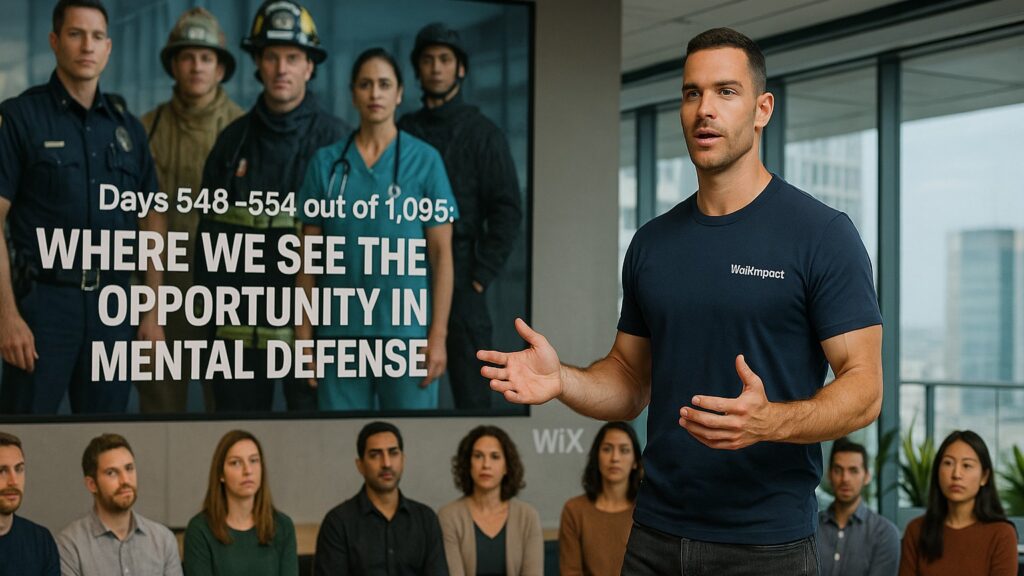
For us, this opportunity is called Mental Defense — a new category we’re building at the intersection of AI, trauma recovery, and resilience.
Why now? Because the national tragedy of October 7th forced us to look at the human cost of trauma not as numbers, but as faces: friends, families, colleagues, and entire communities carrying invisible wounds. What started in Israel is not only a local challenge. PTSD is global. It’s silent, expensive, and growing.
The numbers are chilling:
- The global mental health market grows at 15.3% CAGR.
- PTSD’s economic cost in the U.S. alone is $232 billion annually.
- In Israel, the next 5 years could cost 198 billion NIS, according to the MayFes report.
- 1 in 14 people will experience PTSD. For first responders and security forces, it’s 1 in 5.
But numbers don’t carry the weight of a father who can’t sleep, a medic reliving a scene every night, or a teenager who freezes at the sound of a siren.
This is why we built three workstreams:
- Clinical AI product: a proactive tool that empowers security forces, emergency teams, and families to detect trauma early and strengthen resilience.
- Fundraising: refining our deck, one-pager, and identifying partners who share the mission.
- Tech recruitment: building the team that will translate vision into code.
Each track feels like climbing a mountain with no summit in sight. But that’s entrepreneurship: you walk not because the mountain is easy, but because what’s on the other side matters.
Along the way, I’ve learned a few things worth sharing. If you’re building in tough markets, here are 10 lessons that help me stay grounded:
- Name the problem clearly — numbers alone don’t inspire, but they validate urgency.
- Anchor in emotion — people invest in missions, not just metrics.
- Prototype resilience — test your solution early with real users; healing is complex.
- Recruit beyond skills — trauma-tech needs people with empathy, not just code.
- Update often — a deck is not a one-time document; it’s a living story.
- Balance vision and survival — big dreams matter, but cash flow keeps the lights on.
- Talk to families — the secondary circle often knows the silent struggles best.
- Look abroad early — trauma is global; solutions must cross borders.
- Respect timing — some investors buy into urgency, others into inevitability.
- Celebrate small wins — they’re the only fuel in the long middle stretch.
So yes — it’s hard. It’s uncertain. But the opportunity is bigger than us. We’re not just chasing market share. We’re chasing a future where resilience is accessible in every household, from Tel Aviv to New York, from Kyiv to Berlin.
The middle of the journey is messy. But it’s also where movements are born.