

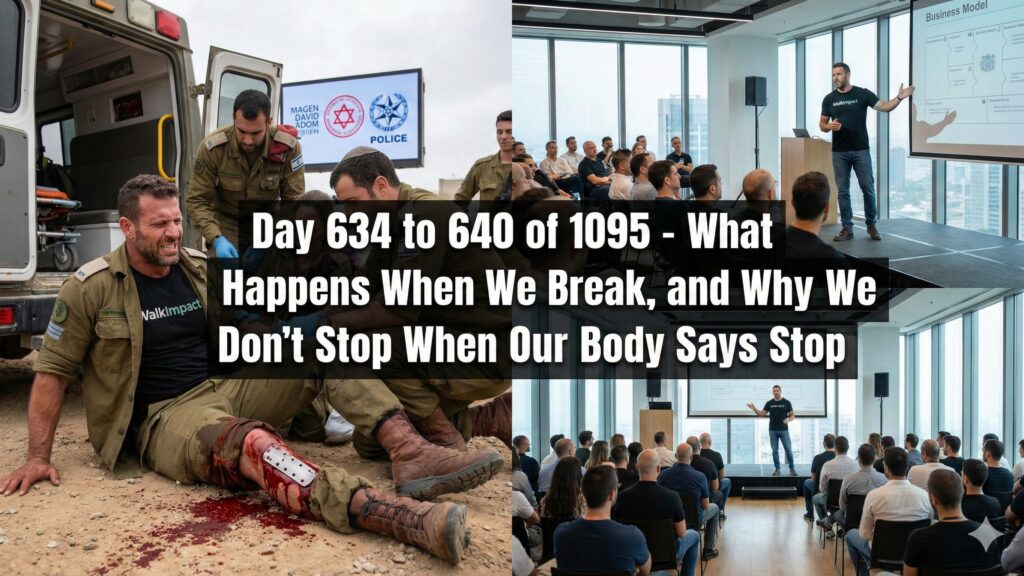
A painful lesson on leadership, limits, and the psychology of "I'm fine."
It hurts to type this. Physically hurts.
I am writing these words through a haze of painkillers, trying to find a comfortable position that doesn't exist.
For the past few months, I have been pushing myself and my body to the absolute edge. I ignored the signs. My body tried to warn me – a mild cold here, a wave of exhaustion there. It was raising red flags, begging me to stop. But in the jungle of Miluim (reserve duty), building a startup, and managing "life," those flags were invisible to me.
I kept charging forward. I convinced myself that a handful of vitamins and one extra hour of sleep would fix the machine. I told myself I was resilient.
And then, just when the schedule was supposed to get extreme – I crashed.
I didn't just slow down; I came to a complete, screeching halt. I am badly injured. Moving is agony. Meetings, events, critical commitments – everything has been cancelled and replaced with blood, bandages, and intense pain. Suddenly, we are not talking about taking a "mental health day." We are talking about basic functioning.
I tried, of course, to manage the world through my smartphone from bed. But the pain is a strict teacher. It made me realize that right now, I have no choice. I must rest.
The Psychology of the Crash
Lying here, unable to move, I was struck by a realization that chills me more than the injury itself. This is exactly why we pivoted our product to focus on "Support Circles."
Psychologically, human beings are terrible at self-treatment. We rarely stop when things are "just" hard. We wait until we hit rock bottom. We wait for the crash.
My own support circles – my friends, family, colleagues – they saw this coming. They commented. They asked. They told me I needed to stop and listen to myself.
And I? I "fake listened." I nodded. I slowed down for a second, just for show, and then revved the engine again.
The result is that I missed important events I desperately wanted to attend. The result is that the workload is now piling up – the pilot infrastructure, the commitments, the fundraising – all waiting for a guy who can barely sit up.
The Lesson for Our Mission
This personal failure to stop highlights the tragedy we are trying to solve on a national scale.
People around us – those who love us – can see when we are at the edge. They see the red flags. In the tragic cases of soldier suicides and PTSD spiraling out of control, the families almost always say later: "We saw the signs."
But seeing isn't enough. Often, they don't know what to say or how to intervene effectively to make us stop before it's too late. Before the irreversible happens.
This is our mission. It is a holy work. I am filled with gratitude that we are just a few steps away from giving these families the tools to help meaningfully. To reach every home, every fighter, every paramedic, every first responder in Israel after October 7th, and eventually, the world.
But for now, I am going to bite the pillow to manage the pain and try to sleep. Hoping to wake up differently tomorrow, but mostly hoping to remember that I must stop.
10 Lessons on Listening to the Body (Before the Crash)
While I recover, here are 10 takeaways for anyone running on fumes right now:
- Respect the Whisper: Your body whispers before it screams. A lingering cold or irritability is a tactical alert, not background noise.
- The "Superman" Fallacy: Believing you can power through anything with caffeine and will-power is not resilience; it’s negligence.
- Trust Your Mirrors: Your friends and family are your mirrors. If three people tell you you look exhausted, you don't need a mirror, you need a bed.
- redefine "Stopping": Rest isn't a sign of weakness; it's a maintenance interval for a high-performance engine.
- The Cost of Denial: A preventative day off costs 24 hours. A crash costs weeks. Do the math.
- Actionable Empathy: When you see a friend at the edge, don't just ask "how are you?" – offer a specific way to take a load off their shoulders.
- The Mobile Trap: Managing a crisis from your phone isn't resting. True rest requires disconnecting the brain, not just the legs.
- Buffer Zones: Build margins into your schedule. If a minor injury collapses your entire workflow, the system was too fragile to begin with.
- Vulnerability is Leadership: Admitting you are in pain and need to cancel isn't failing; it's leading by example.
- Acceptance: Sometimes, you just have to bite the pillow and wait. You can't negotiate with biology.
Stay safe, and please – listen to yourselves.