
Some days, the startup rollercoaster throws you a loop and the wisdom to ride it better next time.
After a crazy prep day for our upcoming investor summit, I realized something painfully simple: It’s not enough to have a mission. You need to show the money. And more importantly: how you're not losing it.
The Cost of Inaction
When you’re building in the resilience and mental health space, your “customer pain point” isn’t a UX problem. It’s an actual human breakdown.
Here’s what the numbers show:
- Early support after trauma: Success rate: 80% | Cost: $2.5K
- Delayed support (3–6 months): Cost: $25K+
- PTSD left untreated: Cost: $40K/year in productivity, healthcare, turnover
Now imagine 50 reservists out of 1,000 employees. Total preventable cost? $2M/year Cost of early support? $100K tops.
Why the Market Is Listening
- US employers spend $200B/year on mental health
- $550B lost in productivity from untreated mental health issues
- 90% of large employers plan to increase investment in this space
- The corporate wellness market is expected to reach $70B+ by 2027
- ROI? $4 returned for every $1 invested in mental wellbeing
This isn’t niche anymore. It’s mainstream—and it’s measurable.
What Makes WalkImpact Different
We’re not an app. We’re not a hotline. We’re not a band-aid for a crisis that already happened.
WalkImpact is a micro-coach, sent through WhatsApp, that helps users move, breathe, and build resilience before trauma explodes. It’s proactive. Accessible. And grounded in behavioral science.
- Movement
- Mindfulness
- Community
- Cultural context (soldiers, medics, first responders)
- And most importantly: data-backed impact reports
So… How Do You Build a Sustainable Business Model in This Space?
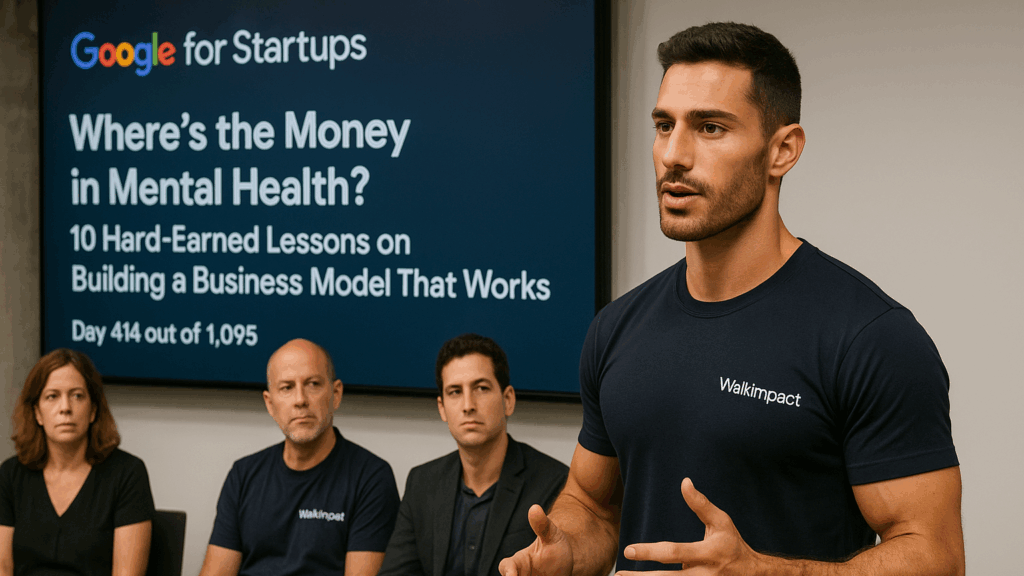
Here are 10 things I’ve learned (the hard way):
- Don’t fall in love with the tech. Fall in love with the problem you’re solving. The model comes from the pain.
- Map the cost of NOT using your product. What's the financial damage when your solution is absent?
- Anchor your model in timing. In trauma, timing = money. The earlier you help, the cheaper the long-term cost.
- Use analogy bias. Help investors feel the value: "Would you let your star player run without treatment?"
- Sell in the language of ROI, not empathy. Empathy wins hearts. ROI wins budget.
- Get creative with GTM. Think beyond B2B or B2C. Try N2N2B, sponsorships, licenses, CSR-driven bundles.
- Track everything. Every walk. Every mood shift. Every “small win” is a data point for future deals.
- Simplify onboarding. No one wants another app. Meet them where they are (e.g., WhatsApp, Slack).
- Focus on early adopters with deep motivation. Military units, HR leaders post-crisis, insurers seeking innovation.
- Remember: mission + margin = impact. You're not selling therapy. You’re creating capacity—at scale.
Final Thought
Business models don’t come from slides. They come from sweat, questions, and listening to the silence after a tough day. Today’s silence said: You’ve got something that works. Now prove it.
We’re not done. But we’re clearer.