

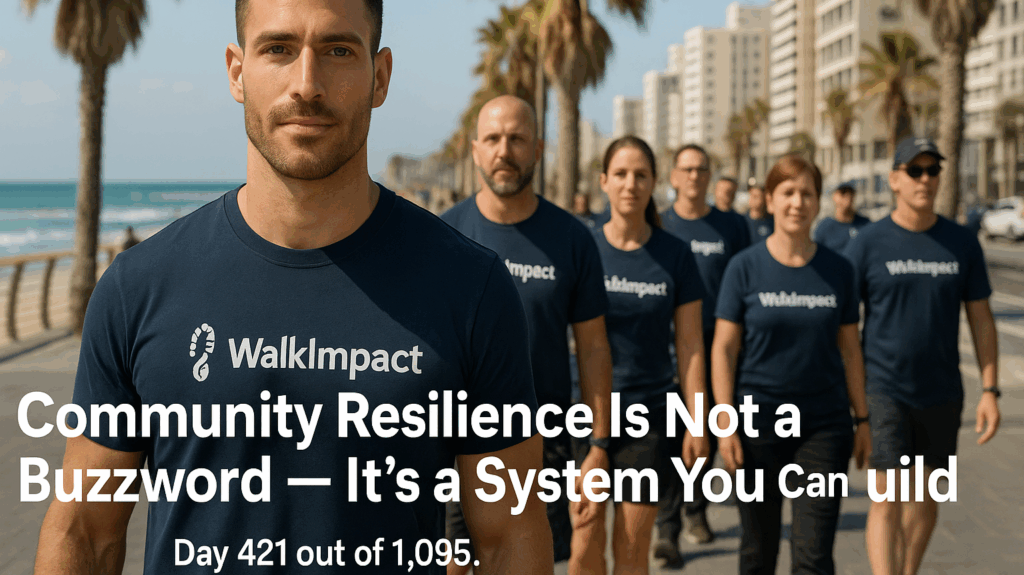
Day 421 out of 1,095. That’s how far we are into building a startup that didn’t start with a product — it started with a pain.
On day one, we weren’t talking about market size or LTV/CAC. We were talking about loneliness. About what happens when your community breaks — and how some rebuild faster than others.
That’s what community resilience is. Not some abstract, NGO-flavored term. But a real, operational capacity: How fast can your people — your team, your network, your city — come back online, emotionally, functionally, together?
And yes, technology has a huge role to play.
The problem: Today’s tech platforms are great at engagement, but terrible at empathy. They optimize for clicks — not cohesion. They help you broadcast, but not belong.
What if we flipped that? What if we designed technology to build trust, detect disconnection, and empower real-time reconnection?
That’s exactly what we’re building.
Not because it sounds good in a pitch deck. But because if you’ve ever watched a community fracture — whether it’s an organization, a city, or a family — you know: resilience is life-saving.
So, how do you actually build community resilience inside your organization? Here are 10 practical tips we've learned on our journey:
- Measure belonging, not just engagement. Use surveys or tools that track emotional connection, not just activity.
- Design for moments of reconnection. After conflict, after burnout, after absence — create rituals that bring people back in.
- Reward vulnerability. Culture shifts when the leadership models honesty, not perfection.
- Build “empathy infrastructure.” Regular check-ins, mental health support, peer coaching.
- Decentralize responsibility. Don’t make resilience HR’s job. Make it everyone’s.
- Make invisible struggles visible. Use anonymized data or stories to surface the real emotional state of the team.
- Train leaders in psychological safety. A resilient team starts with a safe room.
- Embrace hybrid as a feature, not a bug. Design culture intentionally for digital-first connection.
- Use AI with emotional intelligence. Tech should listen before it speaks.
- Tell stories of bouncing back. Normalize adversity. Celebrate recovery.
We’re on day 421. Not even halfway through this 3-year climb. But if there’s one thing we’ve learned — it’s this:
Communities don’t bounce back because they’re strong. They bounce back because they’re connected.
Want to build that kind of connection? Let’s talk.