

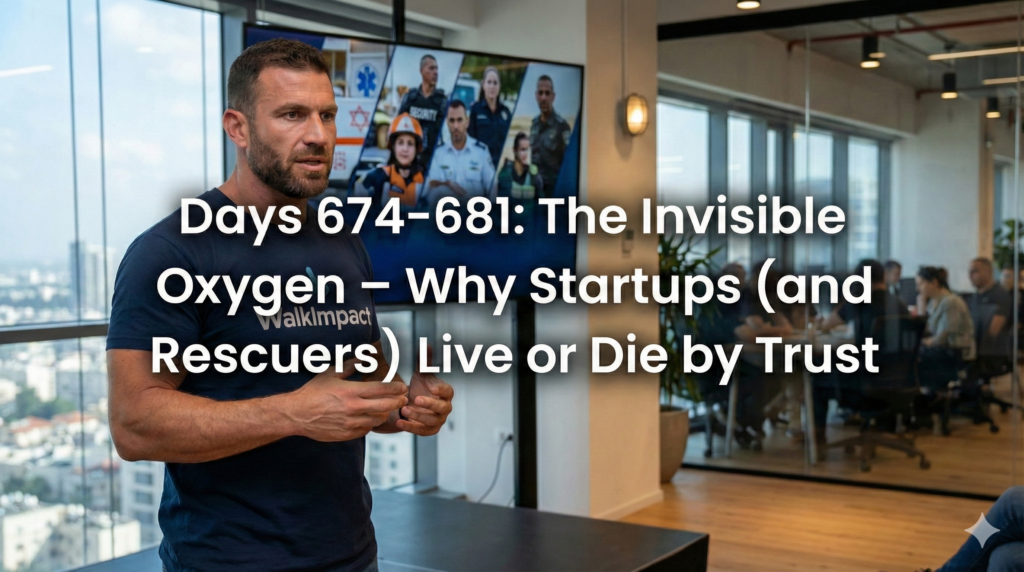
joThe Journey: 1095 Days | Current Location: Day 681
If you walk into a room where a team has lost trust, you don't just see it. You feel it.
It’s a heaviness in the air. A static noise that drowns out creativity. It is the sound of things not being said.
We are currently between Day 674 and Day 681 of this journey. We are deep in the trenches. And lately, I’ve been obsessed with one question: What is the anatomy of trust?
In a startup, we often talk about product-market fit or burn rate. But the team is the engine. And trust? Trust is the oil. Without it, the friction increases. At first, it’s just heat. Then smoke. And eventually, the engine seizes. It dies a slow, painful death.
But here is the complexity: We are building a product for security and rescue forces—people who operate at the extreme edge of human experience. For them, trust isn't about "company culture." It is a matter of life and death. If they don't trust the person next to them, they freeze.
So, as a Founder and CEO, I look at my team, and I look at our users, and I realize we are asking the same questions.
Is Trust Magic or Mechanics?
We often treat trust like "chemistry." We say, "We just clicked," or " The vibe was off." We attribute it to luck or energy.
But that is a dangerous simplification.
If trust were just luck, we couldn't rebuild it when it breaks. And it will break. Startups are pressure cookers. There are gaps between expectations and reality. There are hard conversations that need to happen but often don't.
I am learning that trust is not a feeling; it is an action. It is the willingness to bridge a gap when every instinct in your body tells you to retreat.
The 3D Reality of Conflict
How do we grow from a crisis? How do we take a team-or a user dealing with trauma—and help them move from fragmentation to unity?
It requires stepping into the fire. It requires managing difficult conversations not as a battle to be won, but as a bridge to be built.
I admit, I don't have all the answers. I am navigating this just as you are. But I know that for our users at the edge, and for us building for them, we need a roadmap.
Here are 10 principles-a "Field Guide"-for building and restoring trust when the pressure is high.
The Trust Field Guide: 10 Keys for the Trenches
Assume Positive Intent: When things go wrong, the brain defaults to "they did this to me." Shift the narrative. Assume they are doing their best with what they have.
Define the "Hard" Conversations: Don't let tension simmer. Name the elephant in the room immediately. Silence breeds suspicion.
Vulnerability is Data: Sharing what you don't know isn't weakness; it's giving your team accurate data about the situation. It invites them to help.
consistency Over Intensity: Trust isn't built in one heroic off-site meeting. It is built in the small, boring commitments kept every single day.
The "Gap" Analysis: When there is a conflict, identify the gap. Is it a gap in information? A gap in values? Or a gap in style? don't attack the person; attack the gap.
Create Psychological Safety: Team members must feel they can take a risk or make a mistake without being "shamed." Innovation dies without this.
Listen to the Body: In high-stress meetings, watch the non-verbal cues. Crossed arms, shallow breathing. Address the energy, not just the words.
Shared Trauma needs Shared Healing: Just like our users, a startup team goes through trauma (pivots, failures). Acknowledge it collectively. Don't brush it under the rug.
Feedback as Fuel: Reframe feedback. It is not a critique of character; it is a mechanism for calibration. Make it continuous, not sporadic.
Commit to the "We": Finally, ask the hard question: "Are we committed to crossing this river together?" If the answer is yes, every problem is solvable.
The Bottom Line
We are trying to solve big problems for people in extreme situations. We cannot do that if our internal foundation is shaking.
Trust is the decision to stay in the room when it gets hard. It is the choice to believe that the friction we feel is not the end of the road, but the heat of forging something stronger.
This is true for my team. It is true for our users. And it is true for you.
See you on the next leg of the journey. Eliav