

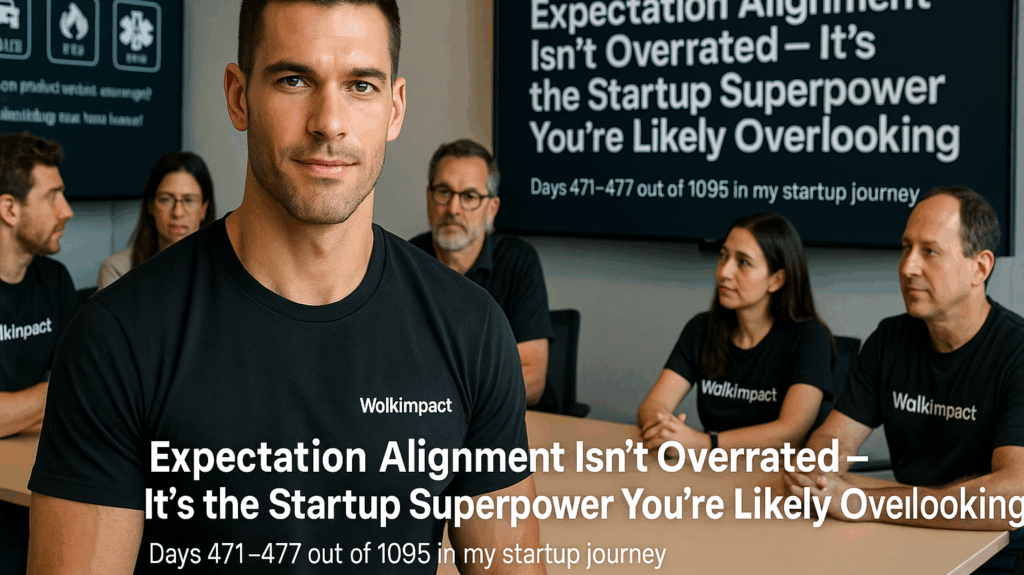
There’s a strange thing about clarity: we often assume it’s there, just because we said the words out loud.
But this week, between reserve duty, deadlines, and a few high-stakes meetings ahead, I was reminded—again—why alignment is never automatic.
We had to prepare for some significant changes in both our product direction and team structure. And like any good team, we scheduled prep talks. We discussed values. We looked at our roadmap.
Here’s the catch: even when we used the exact same words, we meant different things.
Let that sink in for a second.
“Fast,” for one person, meant shipping within the week. For another—it meant planning well and executing next sprint. “Ownership” for some meant “be the one to execute.” For others—it was “challenge the plan.” Same vocabulary. Different movies.
And when this happens quietly, misalignment hides in plain sight. Until it costs you.
So, we stopped. Talked. Reframed. Asked questions. Aligned.
The Cost of Not Aligning
According to McKinsey, companies with effective internal communication are 25% more productive. Yet, most teams skip pre-meeting alignment thinking it’s a luxury. It’s not.
It’s the price of admission for meaningful progress.
In early-stage startups, where speed is worshiped and time is scarce, this can feel counterintuitive. But this small investment creates leverage: aligned teams make decisions faster, build with purpose, and adapt together.
The Route We Took (So You Can, Too)
- Pre-meeting prep: Each member wrote down their understanding of the goal, independently.
- Word check: We clarified emotionally-loaded terms: “fast”, “lean”, “explore”.
- Expectation mapping: Who expects what from whom, and by when.
- Shared “failure” signals: Defined what “off-track” looks like—so we can catch it early.
- Revisited our values: Are we acting in line with what we say we care about?
- Visual alignment: Drew simple sketches of the roadmap to avoid abstract traps.
- Time-boxed talks: We limited alignment sessions to 20 minutes. Forced clarity.
- Asked one golden question: “What do you think I expect from you?”
- Closed with roles + confidence levels: Each person shared what they’re owning and how confident they feel (1–5).
- Reflected post-meeting: What worked? What to tweak next time?
What It Felt Like
There was a moment—15 minutes in—where I could feel the air shift. The tension dropped. We weren’t protecting egos. We were building clarity.
And when that happens in a team? It feels like momentum with direction. Like being on a rope team on a steep mountain—each person pulling their weight, synced. Not faster, but smarter.
The Deeper Insight
People don’t need control—they need clarity.
And clarity is not about explaining more. It’s about pausing to verify meaning, to rehearse alignment, and to design conversations that uncover what's unsaid.
So—how aligned is your team, really?
When the stakes rise, do you align more—or rush forward hoping for the best?
Share how you prepare your team for change. What’s worked? What surprised you?